Keep Clear of Limbs, Lines and Leaning Trees
Keep away from damaged trees and branches; OSHA identifies falling branches and overhead lines as tree-care hazards. Call about the tree from a safe place, describing what you can already see.
The limb
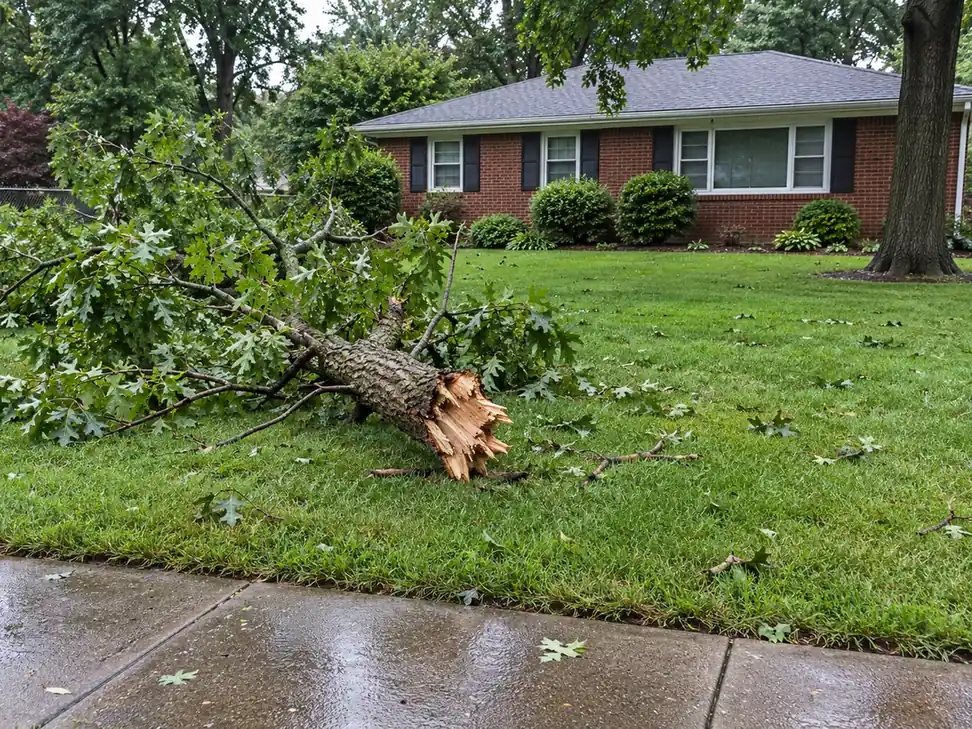
Stay out from under a cracked, broken or hanging limb, and keep people, pets and cars clear; OSHA identifies hanging broken limbs as work-area hazards. Leave the limb alone rather than pulling, shaking or cutting it, following the safety principle of avoiding work beneath hanging wood.
Call about branch removal and describe where the limb hangs relative to a drive, doorway or fence.
The line
Treat any downed or sagging wire as live, and stay well away from the wire and anything touching it, as Ameren's electrical safety guidance advises. Keep family members and pets clear, and never touch a branch lying on a line, because electricity can travel through objects in contact with wires.
Call Ameren Illinois or Ameren Missouri to report downed lines, or call 911 for an emergency. Tree trimming near utility lines needs utility coordination; Ameren gives separate contacts for Illinois and Missouri tree concerns.
The lean
Keep away from a tree with a new or increasing lean, especially where soil or grass has lifted near its base; a recent lean and lifted soil are signs needing assessment. Do not approach the trunk to test movement; leave assessment of the tree and its surroundings to a professional, consistent with Minnesota Extension's advice to seek professional help for severe tree problems.
Call to describe the change and discuss tree assessment or removal.
After a storm
Keep clear of damaged trees and wires while looking over the yard; the National Weather Service advises checking property only after the severe-weather threat has ended. Choose daylight for any walk through clear areas, and stay outside damaged areas to avoid downed or weakened trees and large debris.
For documentation, take photos from a safe distance and retain a written description and receipts. Leave branches pinned or bent under other wood untouched, because OSHA identifies wood held under stress or tension as a cutting hazard. Call about storm cleanup without waiting to collect photographs.
Why climbing and saw work is for trained people
Keep both feet on the ground and stay outside the cutting area; OSHA calls for tree-trimming training and fall protection for work aloft. Tree trimming and tree removal involve falling wood, electrical hazards and equipment, so leave climbing and saw work to trained people, as reflected in OSHA's tree-care safety resources.
Call about high branches rather than trying to reach them.
Stumps and digging
Stay outside the grinder's work area; OSHA includes stump-grinder hazards in its tree-care safety resources. Underground utilities need attention before ground-disturbing work, with free 811 locate requests through JULIE in Illinois and Missouri 811.
Call about stump grinding now and discuss locate arrangements as part of planning the work.