
The quick answer
- Safety and location come first: keep away from damaged trees and wires while the tree's ownership is established.
- Public property changes permission requirements; removing a public tree may need the town's permission.
- Shared boundaries need attention because a fence alone does not establish who controls the tree or authorizes work.
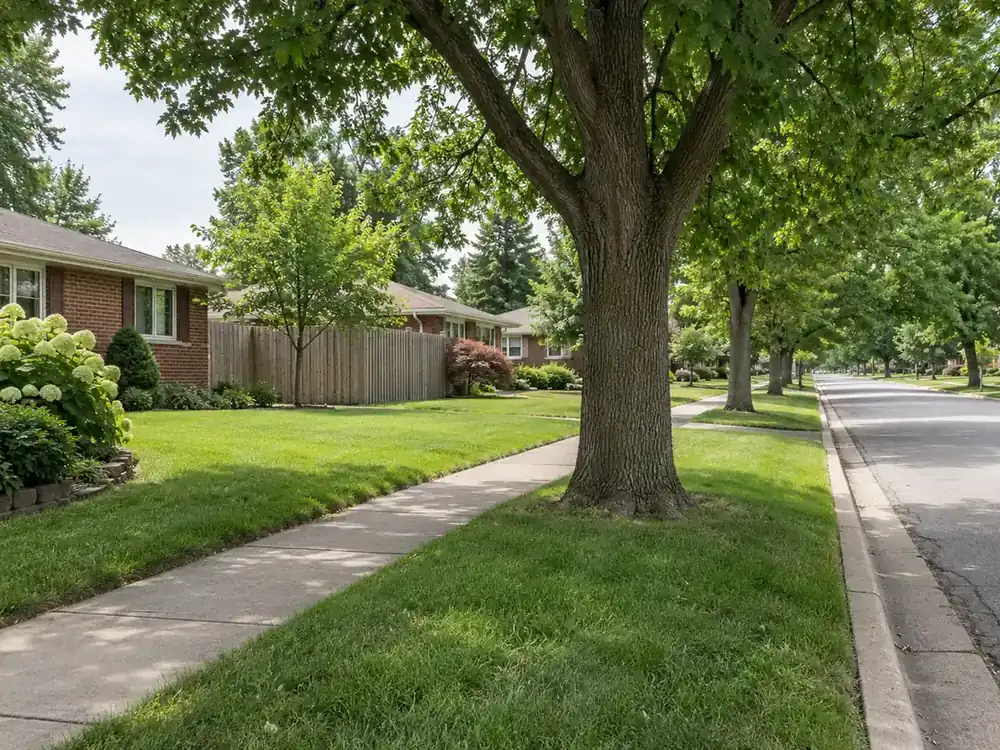
Permission Depends on the Tree's Location
Stay outside the reach of a cracked limb or leaning tree while permission is checked. A tree removal permit concerns authorization for work; the tree's condition still needs professional attention. Call now and describe the location from somewhere safe. Your technician can check the town's requirements alongside the removal plan.
Public trees and private yards
Keep people and parked cars away from damaged branches beside the sidewalk. The strip between a sidewalk and curb may be public right-of-way, so proximity to your house does not establish permission to remove its trees.
Removal, planting or trimming on public property may need the town's permission. Your tree pro can discuss whose tree it is and check which permission requirements apply to the proposed work. Describe the tree's location during the call so ownership and authorization can be addressed alongside the removal plan.
A private-yard location needs its own check rather than a conclusion borrowed from a neighboring town. Ask the municipal planning or public works office which rules govern the address. A tree cutting permit and a building permit should not be assumed to authorize the same work. One of our local tree service partners will discuss the proposed scope while the relevant permission is checked.
| Tree location | Issue to resolve | Contact for the issue |
|---|---|---|
| Entirely inside a private yard | Rules applying to the proposed removal | Municipal planning or public works office |
| Public planting strip | Authorization for work on a public tree | City department managing street trees |
| Beside a disputed boundary | Location of the line and consent | Surveyor and local property attorney |
| Touching an electric wire | Electrical safety and line clearance | Electric utility |
City street trees in St. Louis, Missouri
Give a damaged curbside tree plenty of space. To establish whether the city will remove trees along your frontage, start with who manages the tree. The City of St. Louis Forestry Division plants, maintains and removes street trees in the public right-of-way. Report a concern about tree removal on city property to Forestry; a private removal request does not authorize public-tree work.
Shared trunks and overhanging branches
Avoid the area beneath a split branch extending across a fence. Tree removal on a property line needs a clear understanding of the boundary and authorization. A surveyor can establish the line; a local property attorney can address consent, disagreements and laws about tree cutting involving neighbors.
Tree trimming over a property line also calls for care about ownership and the effect on the whole tree. Dead tree removal responsibility should be discussed with the relevant owners and, where disputed, a property attorney. Keep photographs limited to views available from a safe distance. Call about the tree while boundary questions are being resolved.
Utility wires and the work plan
Treat sagging or downed wires as energized and stay well away. Ameren's electrical safety advice says to keep away from lines and objects touching them and report the location. Contact Ameren Illinois in Illinois or Ameren Missouri in Missouri; call 911 for immediate danger. Utility line work belongs with the utility.
For a tree removal permit application, your technician can discuss the tree's location, visible condition and planned work with the town. The work plan should also specify access, wood removal and the treatment of the remaining stump.